

Buying an investment property involves more than evaluating the purchase price, projected rent, financing, and repairs. Investors must also decide how they will hold title to the property.
One of the most common questions is whether every rental or investment property should have its own limited liability company, or LLC. For many Florida investors, a separate LLC for each property offers the cleanest way to separate risks. However, it is not automatically the best choice in every situation.
The right answer depends on the property’s equity, financing, insurance, intended use, ownership group, and the cost of maintaining multiple entities.
The short answer: If the goal is maximum practical separation between properties, one properly maintained LLC per property is often the preferred structure. Nevertheless, investors should coordinate the decision with their lender, insurance agent, attorney, and tax professional before signing a contract or transferring title.
Not legal advice. This article is general education for Florida property investors. It is not legal, tax, or financial advice and does not create a professional relationship. Your own attorney and CPA should review your situation before you act — there is a fuller note at the end of this article.
Why investors use one LLC per property
The primary reason is risk isolation.
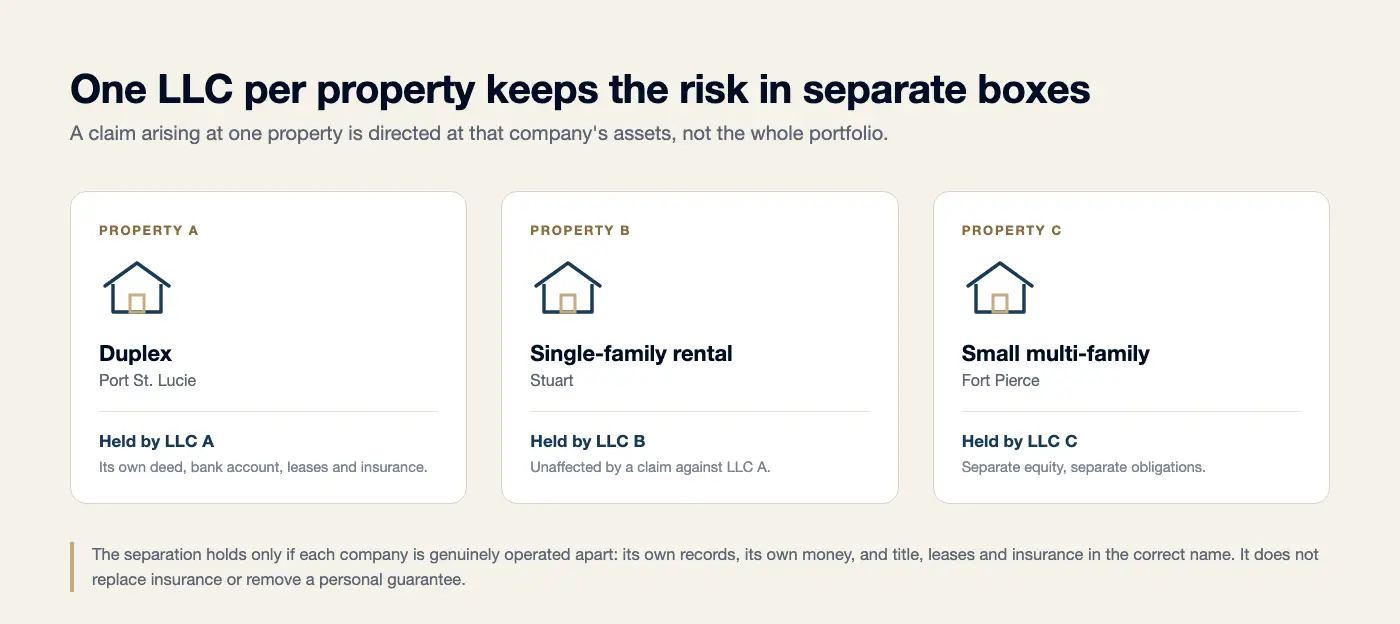
Imagine that an investor owns three rentals in one LLC. If a serious claim arises from an accident at the first property and the resulting liability exceeds available insurance, all three properties are assets of the same company. That potentially places the equity in the entire three-property portfolio within the same liability bucket.
If each property is held in its own properly operated LLC, a claim associated with Property A would generally be directed toward the assets of LLC A. Properties B and C are owned by different companies and are therefore intended to remain outside that particular company’s obligations.
Florida law generally provides that an LLC’s debts, obligations, and liabilities belong to the company, and a person is not personally liable for them solely because that person is a member or manager of the LLC. This is the central benefit of using an LLC, but the protection is not unlimited.
What an LLC does — and does not — protect
An LLC may help separate the financial risks of the property from the owner’s other assets, but it should never be treated as a substitute for good insurance or responsible property management.
An LLC generally does not eliminate:
- Liability arising from an owner’s own wrongful or negligent conduct
- A mortgage, loan, or lease that the owner personally guaranteed
- Liability created by fraud or an improper transfer of assets
- Claims that are covered by an agreement signed in the owner’s individual name
- Problems caused by failing to place the deed, leases, contracts, and insurance in the correct entity name
Investors should continue carrying an appropriate landlord or commercial property policy, strong liability limits, and umbrella or excess coverage when available. The policy should identify the correct property owner and any other parties that the insurance professional recommends.
Is one LLC for several properties ever reasonable?
Yes. Some investors initially group multiple properties into one LLC to reduce filing, legal, and bookkeeping costs. That approach can be reasonable when the properties have little equity, similar ownership, compatible financing, and strong insurance coverage.
The tradeoff is that every property in the company is generally exposed to obligations of that company. As equity grows, many investors decide that the savings no longer justify placing several valuable properties in the same risk pool.
A useful question is not simply, “How many properties do I own?” It is, “How much equity and potential liability am I placing inside this one entity?”
The cost of separate Florida LLCs
As of September 2026, the Florida Division of Corporations lists a required filing cost of $125 to form a Florida LLC. Each LLC also has a $138.75 annual-report fee. An annual report received after May 1 costs $538.75 because of Florida’s $400 late fee.
For example, five conventional property LLCs would generate $693.75 in regular Florida annual-report fees, before any attorney, accountant, registered-agent, bookkeeping, banking, or tax-preparation expenses.
Those costs should be compared with the equity and risk being separated. Paying several hundred dollars per year to isolate several high-equity rentals may be an easy decision. The same structure may feel inefficient for a new investor purchasing one highly leveraged property.
Does an LLC change how rental income is taxed?
Creating an LLC does not automatically create an income-tax advantage.
The IRS generally treats a domestic single-member LLC as a “disregarded entity” for federal income-tax purposes unless it elects corporate tax treatment. When an individual owns the LLC, ordinary rental activity is generally reflected on the owner’s federal return, commonly on Schedule E.
Therefore, owning five properties through five single-member LLCs does not necessarily mean filing five separate federal income-tax returns. It does, however, require clean records for every company. Ownership involving a spouse, partner, corporation, trust, or tax election can produce different results, so investors should obtain individualized tax advice.
An LLC is primarily a legal ownership and risk-management tool — not an automatic tax-saving strategy.
Financing may determine the answer
Financing is often the biggest obstacle to placing each property in its own LLC.
Many conventional residential mortgages require the borrower to close in an individual name. Commercial and debt-service-coverage-ratio loans are more likely to permit or require an entity borrower, but they may carry different rates, fees, guarantees, prepayment provisions, and underwriting standards.
Investors should decide on the ownership structure before applying for financing. Ask the lender these questions in writing:
- May the LLC take title at closing?
- Will the individual owner have to sign a personal guarantee?
- If the loan closes in an individual name, may the property later be transferred to a borrower-controlled LLC?
- Will a later transfer affect the interest rate, insurance requirements, escrow, or ability to refinance?
Federal law allows lenders to enforce due-on-sale provisions except for specifically protected transfers. A transfer to an LLC is not broadly protected in the same manner as every transfer listed in the federal statute. Fannie Mae’s servicing guidance permits certain transfers to LLCs controlled or majority-owned by the original borrower, subject to detailed requirements. That does not mean every mortgage or servicer must handle an LLC transfer the same way.
Never rely on an informal assurance or assume a lender will overlook a deed transfer. Obtain written approval from the lender or servicer before changing title.
Do not forget insurance
The property owner shown on the deed and the insured named on the policy must be coordinated correctly. Transferring title without updating the insurance can create a dangerous mismatch when a claim occurs.
Before closing or transferring a property, ask an experienced insurance professional to review:
- The named insured and any additional insureds
- Property and loss-of-rents coverage
- Premises and landlord liability limits
- Flood, windstorm, and hurricane coverage
- Renovation, vacancy, builder’s-risk, or short-term-rental exclusions
- Umbrella or excess-liability coverage
This is especially important in South Florida, where windstorm, flood, vacancy, construction, and short-term-rental exposures can materially affect coverage.
Transferring a property you already own can be expensive
Investors sometimes buy in their own names and later record a quitclaim deed transferring the property into a new LLC. That may look simple, but it can create several consequences.
In Florida, documents transferring an interest in real property may be subject to documentary stamp tax. When a property has a mortgage or other lien, the outstanding balance can be treated as consideration when calculating the tax.
A transfer of legal title may also constitute a change of ownership for Florida’s nonhomestead property-tax assessment rules. That can cause the property to be reassessed at just value on the following January 1, and can affect the benefit of Florida’s nonhomestead assessment cap.
The owner should also examine:
- The mortgage’s due-on-sale or transfer provisions
- County recording and documentary-stamp charges
- Title-insurance coverage or endorsements
- Property-tax reassessment
- Existing leases and tenant notices
- Security-deposit records
- HOA or condominium restrictions
- Insurance eligibility and premiums
For these reasons, investors should not prepare and record a deed on their own merely to “put the property in an LLC.” A Florida real estate attorney, tax professional, lender or servicer, title company, and insurance agent should review the proposed transfer first.
A new Florida option: protected-series LLCs
Florida’s protected-series LLC provisions became effective July 1, 2026. Under the new structure, an existing active Florida LLC can establish legally distinct protected series. The Florida Division of Corporations currently charges $25 to designate each protected series, and the protected series do not file their own annual reports.
In theory, one parent LLC could establish a protected series for each investment property while maintaining separate liability compartments and reducing annual state filing costs.
However, this is a brand-new Florida structure. Before using it, investors should confirm that their attorney is comfortable with the required records and asset-association rules and that their lender, title insurer, property insurer, accountant, and any out-of-state parties will recognize the structure as intended.
Until the new system develops a longer operating history, traditional standalone LLCs may remain the more familiar choice for investors who prioritize lender, title, and insurance acceptance.
One important Florida limitation
An LLC is often strongest at protecting an owner from liabilities arising inside the property. Protection in the opposite direction is different.
If the owner personally becomes a judgment debtor, Florida law allows a creditor to seek a charging order against the owner’s LLC interest. In a single-member LLC, a court may potentially order foreclosure of that ownership interest if distributions will not satisfy the judgment within a reasonable time.
That means a single-member LLC should not be marketed as impenetrable protection against every personal creditor. Investors with substantial portfolios should obtain customized asset-protection and estate-planning advice instead of relying on a basic online formation package.
A practical decision guide
A separate standalone LLC is often worth considering when:
- The property has meaningful equity
- The property will have tenants, guests, contractors, or renovation activity
- The loan permits entity ownership
- Different properties have different partners or ownership percentages
- The investor plans to hold and grow a portfolio
- Keeping one property’s risk separate from every other property is a priority
Individual ownership or grouping properties may warrant comparison when:
- The investor owns one property with limited equity
- Conventional financing requires title in an individual name
- Multiple LLC costs would materially reduce the property’s return
- Strong landlord and umbrella insurance is available
- The property has limited equity and does not involve high-risk construction or short-term-rental activity
Even in these cases, the least expensive option is not necessarily the safest one. The decision should reflect the amount of equity at risk, the property’s use, and the investor’s total financial picture.
Best practices when using one LLC per property
For an LLC structure to work as intended, the documentation and day-to-day operations should match the ownership arrangement:
- Form the LLC before signing or closing whenever possible
- Confirm the contract permits assignment or identifies the intended buyer correctly
- Place title in the LLC’s precise legal name
- Use a written operating agreement, even for a single-member LLC
- Maintain a separate bank account and bookkeeping records
- Sign leases and vendor contracts on behalf of the LLC
- Keep security deposits and property funds properly accounted for
- Avoid paying personal expenses from the LLC account
- Maintain the correct insurance in the entity’s name
- File the Florida annual report before May 1
- Document loans, contributions, and distributions between the owner and the company
The bottom line
For a Florida investor seeking the cleanest practical separation of property-related risks, one properly operated LLC per investment property is often the preferred approach. It keeps each property’s equity in a separate ownership bucket and makes it easier to understand which income, expenses, contracts, and liabilities belong to each investment.
The structure is not free, does not replace insurance, does not eliminate personal guarantees, and may create serious complications when an already-financed property is transferred after closing. The best time to evaluate the ownership structure is before signing a purchase contract and before selecting the loan.
If you are evaluating a South Florida investment property, explore current properties for sale and compare the financial potential of each. Then have your Florida attorney, CPA, lender, title professional, and insurance agent confirm the ownership plan before closing.
Frequently asked questions
Can one LLC own multiple rental properties?
Yes. One LLC can own multiple properties, but all assets owned by that company generally sit within the same liability pool. Separate LLCs are intended to isolate each property’s assets and obligations.
Does every property LLC need a separate federal tax return?
Not necessarily. A domestic single-member LLC is generally disregarded for federal income-tax purposes unless it elects otherwise. Rental activity may still be reported on the individual owner’s return. Partnerships, elections, trusts, and other ownership arrangements can change the filing requirements.
Does an LLC replace landlord and umbrella insurance?
No. Investors should maintain appropriate property, liability, and excess coverage even when an LLC owns the property.
Can I transfer a mortgaged rental into my LLC?
Possibly, but the answer depends on the loan documents, investor, servicer, insurance, title, taxes, and other facts. Obtain written lender or servicer approval and professional advice before recording a deed.
Should a house flip have its own LLC?
A flip can involve contractors, vacant-property exposure, construction activity, financing guarantees, and a resale transaction. Those risks often make a separate entity worth considering, but the entity must be coordinated with the acquisition loan, builder’s-risk or renovation insurance, contracts, permits, and closing documents.
Authoritative resources
- Florida Statutes § 605.0304 — Liability of members and managers
- Florida Statutes § 605.0503 — Charging orders
- IRS — Single-member limited liability companies
- Florida Division of Corporations — LLC fees
- Florida Department of Revenue — Documentary stamp tax
- Florida Statutes § 193.1554 — Assessment of nonhomestead residential property
- Fannie Mae — Allowable exemptions due to the type of transfer
- Florida Division of Corporations — Florida series LLCs
Important disclaimer: This article is provided for general educational purposes only. It is not legal, tax, lending, insurance, investment, or accounting advice and does not create an attorney-client or other professional relationship. Laws, administrative guidance, loan requirements, insurance terms, and individual circumstances can change. Consult qualified Florida professionals regarding your specific transaction before forming an entity, signing a contract, obtaining financing, or transferring real property.